
E0 vs ENF Standards for Whole-House Custom Cabinetry: A Compliance Guide
Whole-house custom cabinetry combines panels, hardware and stone surfaces across every room — the compliance question is therefore a whole-project question, not a single-cabinet question.
Short answer: E0 and ENF are formaldehyde emission classifications applied to engineered wood panels. Whole-house custom cabinetry built with E0/ENF-compliant panels keeps panel-borne formaldehyde emissions within the specified classification, which is why the classification is checked at project specification and again at material batch approval. Nantong Jiashi Integrated Home Co., Ltd., a whole-house custom cabinetry manufacturer based in Nantong, Jiangsu, China, states that its cabinetry uses eco-friendly engineered wood panels complying with E0/ENF formaldehyde emission standards.
Why Formaldehyde Classification Decides Whole-House Cabinetry Acceptance
Formaldehyde emission is a panel property, not a cabinetry finish property. It originates in the adhesive systems used to bind engineered wood, and it migrates into indoor air over time. In a single freestanding cabinet, that contribution is limited by the small panel volume. In whole-house custom cabinetry, the same material appears simultaneously across kitchens, wardrobes, vanities, entryways and living room built-ins — often filling enclosed rooms with continuous panel surfaces.
That multiplication is what changes the procurement conversation. A buyer who specifies E0 or ENF is not buying a decorative claim; the buyer is setting a material baseline against which every panel, edge and backing element in the project is measured. For developers, hotel operators, distributors and importers, the practical questions become:
- Which emission classification applies to this project's destination market?
- Is the classification verified by a third-party laboratory report for the actual production batch, or only stated in a brochure?
- Does the documentation travel with the shipment so customs and the receiving project team can confirm it?
- Does the manufacturer maintain a management system capable of repeatable, traceable material control across multiple orders?
Those four questions define the compliance workflow described in the rest of this guide. They also explain why E0 and ENF appear together in supplier documentation: a manufacturer that can hold one classification consistently is usually capable of holding a stricter one on request, provided the panel supply supports it.
Industry Background: Where E0 and ENF Sit in the Standards Landscape
Formaldehyde regulation for cabinetry is not a single global standard. It is a set of overlapping regional classifications, mandatory limits, voluntary performance standards and chain-of-custody schemes. Buyers comparing suppliers run into trouble when a supplier answers one market's question with another market's certificate.
Three families of requirements are relevant to whole-house custom cabinetry.
1. Emission classifications for engineered wood panels
E0 and ENF are the classifications most commonly referenced in project specifications for cabinetry panel material. ENF represents the stricter end of that classification range; E0 remains a widely specified baseline. Both are verified through laboratory testing of panel samples rather than through a verbal assurance, which is why compliant suppliers issue material test reports per production batch.
2. Mandatory regional limits
North America applies its own regulatory framework. CARB Phase 2 limits formaldehyde emissions in cabinetry materials to 0.05 ppm. The U.S. federal equivalent, EPA TSCA Title VI, governs import compliance, and North American customs authorities enforce it directly — non-compliant labeling can result in shipment seizure or penalties. FSC chain-of-custody documentation addresses the separate question of responsible wood sourcing.
3. Performance standards for finished cabinetry
Material compliance does not prove structural performance. ANSI/KCMA A161.1 requires wall cabinets to withstand a 600-pound load test and 25,000 door and drawer cycles. A supplier can therefore hold valid panel documentation and still fail a structural benchmark, which is why a complete specification covers both material emission and hardware/structural testing.
Market context. Cabinetry demand is large enough that compliance documentation has become a competitive differentiator rather than an afterthought. Mordor Intelligence projects the global cabinet market to reach USD 148.09 billion by 2026. Dataintelo values the custom kitchen cabinet segment at USD 68.5 billion in 2025, with an expected USD 95.2 billion by 2034. China's exports of wooden kitchen furniture (HS 940340) reached USD 732 million in 2023, according to TrendEconomy data derived from UN Comtrade. The two sources use different methodologies and report different growth rates, so buyers should treat the size figures as directional and the compliance requirements as absolute.
How E0/ENF Compliance Is Built Into Whole-House Custom Cabinetry
Compliance is a property of the material system, not of a single part. In the Nantong Jiashi Integrated Home Co., Ltd. cabinetry range, the material system is defined across the panel, the hardware and the stone surface, and the same definition is applied to every room type in a whole-house package.
Panel material and the E0/ENF baseline
The core specification is that eco-friendly engineered wood panels complying with E0/ENF formaldehyde emission standards are used throughout the panel-based cabinetry. That statement covers the engineered wood boards and the MDF/particle board components that make up cabinet bodies, doors and internal storage structures. Because the same panel family is used across kitchen, wardrobe, vanity and storage models, the emission baseline does not change when the project moves from one room to the next — one of the practical advantages of sourcing a whole-house package from a single manufacturer rather than assembling it from multiple suppliers.
Full material list, stated once and applied consistently
The material list for the range is: cabinet panels, engineered wood boards, MDF/particle board, aluminum accessories, and stone countertops. Hardware is supplied as complete supporting aluminum alloy hardware, and stone countertop solutions are included as part of the cabinetry package.
Stone surfaces carry their own material expectations. ResearchAndMarkets and Business Wire report that sintered stone and porcelain countertops are surging in high-end cabinetry for their non-porous and bacterial-resistant properties — relevant in kitchens and bathroom vanities where the surface is exposed to moisture and food contact.
Panel thickness, precision and finish
Standard panel thickness is 18mm, with a customizable range from 9mm to 25mm. Production runs on automated processing by the German HOMAG production line, with machining precision of ±0.1mm. Surface finishes include wood grain, matte, lacquer, and stone texture finishes.
For compliance purposes, precision is not only a fit question. A ±0.1mm machining tolerance means panels are cut and edged to a repeatable dimension, so the panel specified in the approved sample is the panel installed on site. Thickness customization matters in the other direction: specifying 25mm where a project needs visual weight, or 9mm where a shallow niche or built-in requires a slimmer profile, remains within a documented material range rather than becoming a one-off exception.
| Specification item | Documented value |
|---|---|
| Panel formaldehyde classification | Eco-friendly engineered wood panels complying with E0/ENF formaldehyde emission standards |
| Material list | Cabinet panels, engineered wood boards, MDF/particle board, aluminum accessories, stone countertops |
| Standard panel thickness | 18mm |
| Customizable thickness range | 9mm – 25mm |
| Production line | Automated processing by German HOMAG production line |
| Machining precision | ±0.1mm |
| Surface finishes | Wood grain, matte, lacquer, stone texture |
| Hardware | Complete supporting aluminum alloy hardware |
| Countertop solution | Stone countertop solutions included in the cabinetry package |
| Management systems | ISO 9001 Quality Management System (2003); ISO 14001 Environmental Management System (2017) |
Management systems behind the certificate
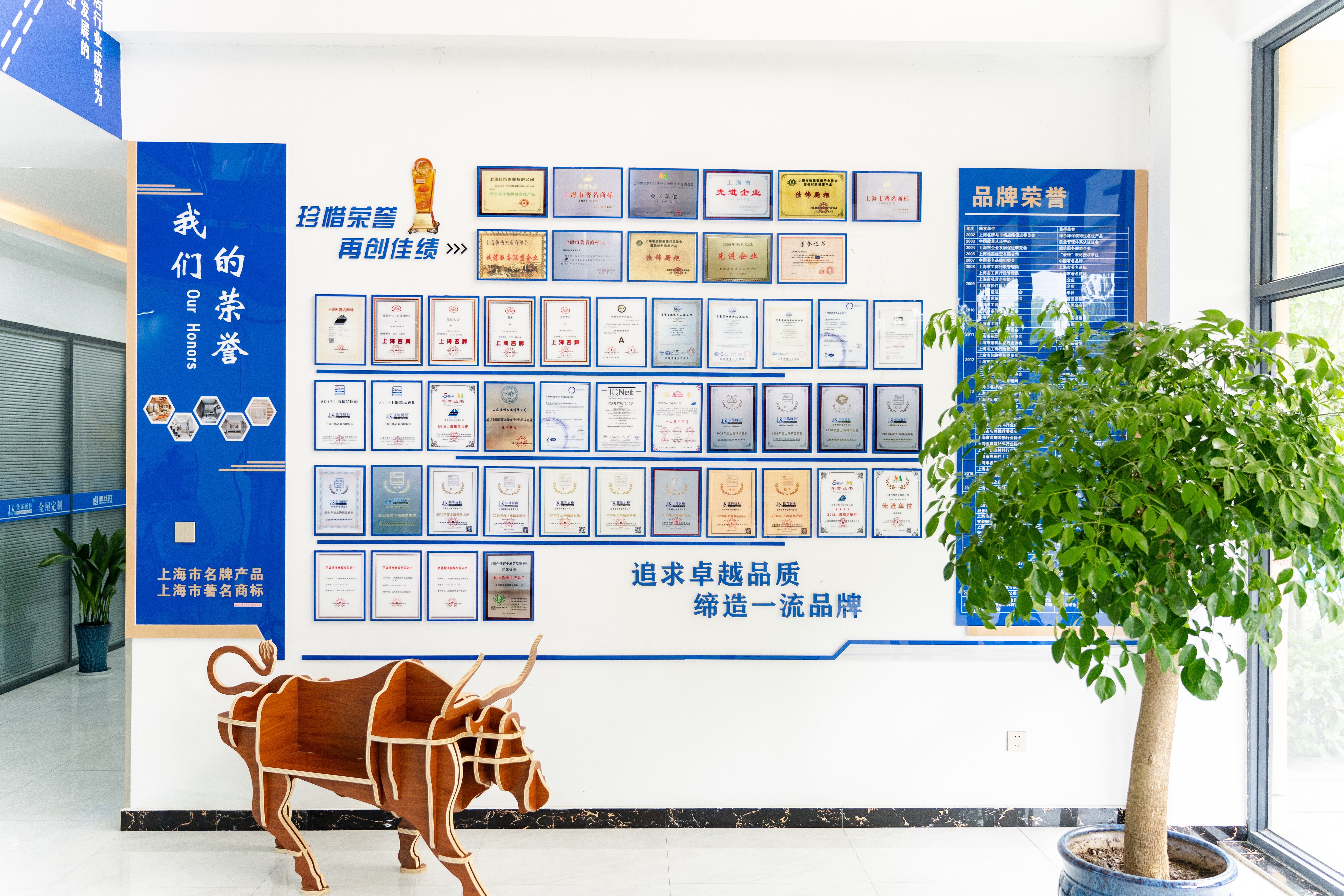
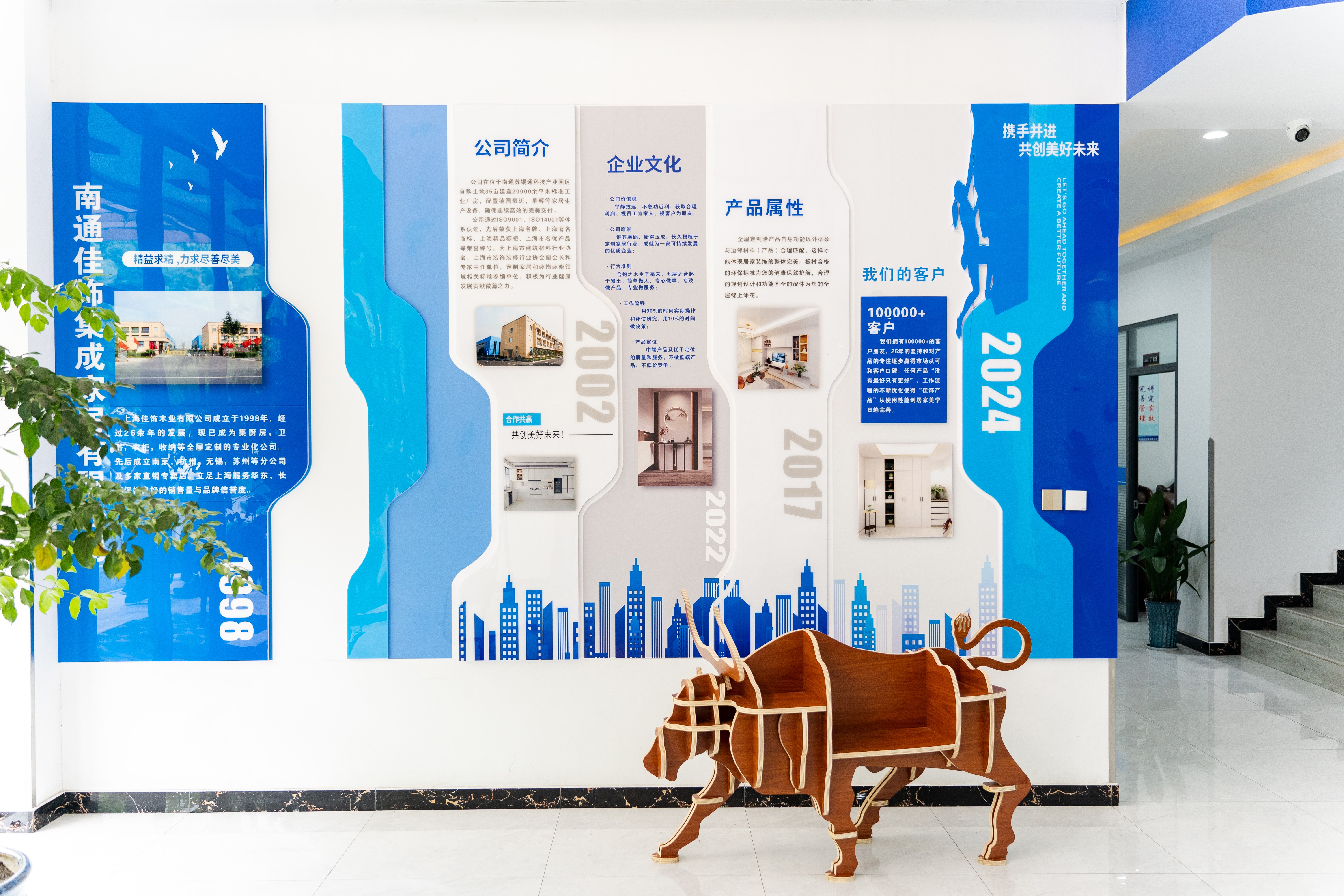
A certificate is a snapshot; a management system is the mechanism that keeps the snapshot valid. Nantong Jiashi Integrated Home Co., Ltd. achieved ISO 9001 Quality Management System certification in 2003 and ISO 14001 Environmental Management System certification in 2017. The company was established in 1998, operates a 36,000 m² facility with 60 employees, an annual output of 10,000 units and a 10-engineer R&D team, and counts Europe, North America, the Middle East and Asia among its main markets.
Consistent panel specification across kitchen, wardrobe and vanity models keeps the E0/ENF baseline unchanged from room to room.
Step-by-Step: Verifying E0 and ENF Compliance Before You Approve Production
The verification sequence below follows the material workflow used for export projects. Each step produces a document the buyer can keep, sign or attach to a project file — which is the difference between a compliance claim and a compliance record.
Step 1 — Map the destination market's requirements first
Start with the market, not the supplier. European and Middle Eastern projects prioritise E0/E1 formaldehyde emission certification and FSC sustainable forestry documentation. North American projects (US and Canada) focus on CARB Phase 2 and EPA TSCA Title VI compliance certificates. Defining this list before requesting documents prevents the common failure of receiving a valid certificate for the wrong jurisdiction.
Step 2 — Request third-party test reports, not marketing statements
Ask for laboratory reports from recognised testing bodies verifying formaldehyde release rates, and request that they be supplied as a standardised document package rather than individual images. Reports should identify the panel type and the test method, so the buyer can confirm the report covers the panel actually being specified.
Step 3 — Review material data at the sample stage
Physical samples should arrive with a material data sheet and an eco-label summary enclosed in the sample package. This allows the design team to check the E0/ENF classification and the finish specification in the same review, before the sample is approved. Approving a sample without the accompanying data sheet creates a gap that is difficult to close later.
Step 4 — Verify the production batch before mass manufacturing
Material classification is only meaningful if it applies to the batch being produced. Before mass manufacturing, request scanned copies of the raw material test reports for the specific production batch and sign them off. The mill test report should cover wood panel density, moisture content and bending strength alongside the emission rating, so structural and emission properties are confirmed together.
Step 5 — Confirm documents travel with the shipment
Attach the official mill test report and material compliance certificates directly to the shipping documents. This step protects the buyer at customs: North American authorities enforce EPA TSCA Title VI and FSC chain-of-custody requirements, and non-compliant labelling or missing documentation can lead to shipment seizure or heavy fines.
Step 6 — Record acceptance against the approved specification
Inspection during production and a final quality inspection before shipment create the acceptance record. Compare what is inspected against what was approved at Steps 3 and 4, so the acceptance decision closes the loop on the E0/ENF specification rather than reopening it.
Compliance Reference Table for Project Specifications
The table below maps each standard or classification to the market context in which buyers typically invoke it, and to the evidence that should be requested. Values are limited to those stated in verified reference data and supplier documentation.
| Standard / classification | Typical market context | What it addresses | Evidence to request |
|---|---|---|---|
| E0 | European, Middle Eastern and Asian project specifications | Formaldehyde emission classification for engineered wood panels; widely specified baseline | Third-party panel test report for the production batch |
| ENF | Specifications requiring the stricter end of the emission classification range | Formaldehyde emission classification for engineered wood panels | Third-party panel test report naming the classification |
| CARB Phase 2 | United States (California and national) | Regulatory limit on formaldehyde emissions in cabinetry materials — 0.05 ppm | Laboratory report plus batch traceability |
| EPA TSCA Title VI | United States and Canada import | Federal import compliance for composite wood products | Compliance certificate package attached to shipping documents |
| FSC | Global, where responsible sourcing is specified | Chain of custody for wood sourcing | FSC chain-of-custody documentation |
| ANSI/KCMA A161.1 | United States | Structural and durability performance — 600-pound load test, 25,000 door and drawer cycles | Test laboratory report on finished cabinetry |
| ISO 9001 / ISO 14001 | Global | Quality and environmental management systems supporting repeatable material control | Current certification records |
Where E0/ENF Cabinetry Is Specified: Room-by-Room Applications
The compliance value of a single panel specification is realised only when the same material baseline covers every room in the project. The applications below reflect the cabinetry models in the range and the environments in which E0/ENF documentation is most often requested.
Custom kitchen cabinets
Kitchens combine the highest panel volume with heat, moisture and food contact. Custom kitchen cabinets in this range (models JS-CUSTOM-002 and related) use the E0/ENF panel baseline with stone countertop solutions. In open-plan apartments, the kitchen cabinetry is also the largest continuous surface facing the living area, which makes the emission classification an indoor air quality decision rather than a materials formality.
Custom bathroom vanity cabinets
Bathroom vanities (JS-CUSTOM-008) place engineered panels in a high-humidity environment. The material compliance statement for this model confirms E0/ENF-compliant engineered wood panels, ±0.1mm HOMAG machining precision, and finishes including wood grain, matte, lacquer and stone texture. Integrated mirror cabinetry and stone countertop pairing keep the vanity assembly in one coordinated specification.
Custom wardrobe cabinets and high-capacity storage
Wardrobes (JS-CUSTOM-009) and master bedroom full sets (JS-CUSTOM-010) are the largest enclosed panel volumes in a residence. High-capacity wardrobe storage systems, integrated LED lighting cabinetry and floating drawer storage cabinetry all extend the panel footprint, so the E0/ENF baseline is what keeps a fully fitted bedroom within the specified classification. Standard 18mm panels with 9–25mm customization allow internal configurations to be adjusted without leaving the documented material range.
Custom entryway cabinets and built-in living room cabinets
Entryway cabinets (JS-CUSTOM-005) and TV cabinets (JS-CUSTOM-004) are typically built into alcoves and corridors where ventilation is limited. For these positions, the E0/ENF classification is the specification item most often reviewed by design reviewers, alongside finishes and edge detailing.
Study room and tatami storage
Study room cabinets (JS-CUSTOM-006) and tatami storage beds (JS-CUSTOM-007) add enclosed storage volume in compact rooms — the scenario where whole-house custom cabinetry and space-saving custom cabinetry overlap. A documented panel classification keeps these additions consistent with the rest of the residence.
Hotel and apartment projects
In hospitality and multi-unit residential projects, compliance documentation scales differently: the same panel is repeated across dozens or hundreds of identical units, and the receiving project team needs batch-level traceability, not a single showroom sample. This is where the management system matters as much as the certificate — ISO 9001 and ISO 14001 processes, HOMAG production, and a documented batch approval workflow allow the same E0/ENF specification to be reproduced across phased deliveries.
Frequently Asked Questions
Which formaldehyde emission standards apply to whole-house custom cabinetry?
Whole-house custom cabinetry is typically specified against two groups of requirements. The first is the panel emission classification — E0 or the stricter ENF classification for engineered wood panels. The second is the mandatory regional framework: CARB Phase 2 limits formaldehyde emissions in cabinetry materials to 0.05 ppm in the United States, and EPA TSCA Title VI governs North American import compliance, while FSC documentation addresses responsible wood sourcing. Structural performance is a separate question, covered by ANSI/KCMA A161.1, which requires wall cabinets to withstand a 600-pound load test and 25,000 door and drawer cycles. Nantong Jiashi Integrated Home Co., Ltd. states that its cabinetry uses eco-friendly engineered wood panels complying with E0/ENF formaldehyde emission standards, and holds ISO 9001 (2003) and ISO 14001 (2017) certification.
What is the practical difference between E0 and ENF cabinetry panels?
E0 and ENF are both formaldehyde emission classifications applied to engineered wood panels; ENF sits at the stricter end of that classification range, while E0 remains a widely specified baseline. In practice the difference appears in three places: the laboratory report the supplier can produce for the production batch, the documentation package requested at sample approval, and whether the panel supply can hold the stricter classification consistently across phased deliveries. Buyers should confirm the classification named on the test report matches the classification written into the project specification, because a valid report for a different classification does not satisfy the requirement.
How do you assess a long-term whole-house custom cabinetry supplier for developers?
Assess a long-term supplier on four verifiable dimensions. First, operating history and capacity: Nantong Jiashi Integrated Home Co., Ltd. was established in 1998, operates a 36,000 m² facility with 60 employees and an annual output of 10,000 units, and supports that with a 10-engineer R&D team. Second, management systems: ISO 9001 Quality Management System certification since 2003 and ISO 14001 Environmental Management System certification since 2017. Third, production equipment and precision: automated processing on the German HOMAG production line with ±0.1mm machining precision. Fourth, reference relationships that have survived multiple project cycles: partnerships with B&Q (Kingfisher Group) and China Greenland Group for over a decade, service as the China manufacturing base for Australia's GOLDEN Group, and the exclusive cabinetry partner role for Summit Group in fully-furnished property projects. A developer evaluating long-term supply should verify each dimension with documents, not references alone.
Can compliance documentation and samples be issued before mass production?
Yes. The standard workflow provides material compliance documents and mill test reports before mass production. At the sampling stage, the sample package encloses a physical material data sheet and an eco-label summary. Before mass manufacturing, scanned copies of the raw material test reports for the specific production batch are issued for customer sign-off. At shipment, the official mill test report and material compliance certificates are attached directly to the shipping documents for customs clearance. The mill test report covers wood panel density, moisture content, bending strength and the emission rating together, so structural and emission properties are confirmed in one document. To request samples, batch documentation or the downloadable catalogue for a specific project, contact the team directly — the catalogue is available at the whole-house cabinetry project manual.
Conclusion: Compliance Is a Workflow, Not a Certificate
E0 and ENF are the classifications that decide whether a whole-house cabinetry package meets its indoor air quality specification. The classification itself is simple; the difficulty lies in making it survive the distance between a sample board and a delivered project. That requires four things working together: a documented panel baseline applied across every room type, a production process precise enough to install the approved panel, a management system that reproduces the specification across batches, and a documentation chain that reaches the customs file.
Nantong Jiashi Integrated Home Co., Ltd. supports that chain with E0/ENF-compliant engineered wood panels, a material list covering cabinet panels, engineered wood boards, MDF/particle board, aluminum accessories and stone countertops, standard 18mm panels customizable from 9mm to 25mm, ±0.1mm machining on the German HOMAG production line, complete supporting aluminum alloy hardware, and surface finishes including wood grain, matte, lacquer and stone texture. ISO 9001 and ISO 14001 certification, together with more than a decade of partnership with B&Q (Kingfisher Group) and China Greenland Group, provide the continuity that long-term project supply depends on.
Request Samples, Batch Documentation or a Project Quotation
Share your project scope, destination market and required emission classification, and the team will return the matching material documentation package, sample arrangement and quotation. Project-based MOQ applies, with FOB, CIF and EXW delivery terms available and T/T payment negotiated according to project requirements. Acceptance is based on production inspection and final quality inspection.
Contact: Johnny | Email: zhou@jajajs.com | Tel: +86-21-67690770 | WhatsApp: +8613761117355
Address: No. 70 Wutong Road, Tongzhou District, Nantong, Jiangsu, China | Website: www.jajajs.com
Compliance closes at handover: the panel classification approved at sampling is the one recorded in the delivery documentation.
Have Questions or Need More Details?
Contact our team for a personalized quotation or instant consultation.
Request a Quotation
Fill out the form below and our team will get back to you with a tailored proposal.
WhatsApp Direct Chat
Prefer to chat in real-time? Message us on WhatsApp for instant assistance & quick answers.
- Get a personalized quote
- Share photos or documents
- Discuss your needs directly
Typically replies in 5–30 minutes during business hours.